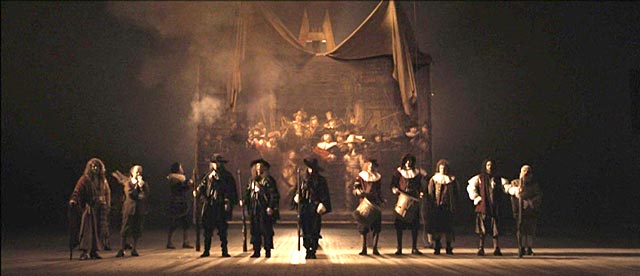
The Night Watch | Original Title: Nightwatching
This was the official site for the 2007 Peter Greenaway film, Nightwatching.
Content is from outside sources including reviews from RottenTomatoes.
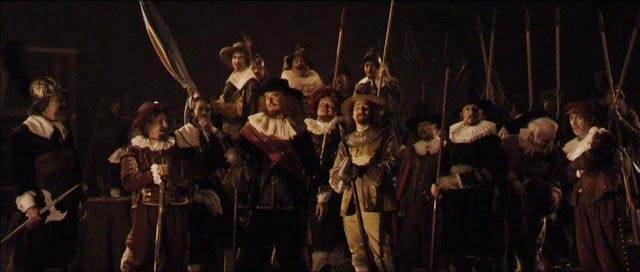
Original title Nightwatching
Year: 2007
Duration: 134 min.
Country: United Kingdom
Director: Peter Greenaway
Script: Peter Greenaway
Music: Wlodzimierz Pawlik
Photograph: Reinier van Brummelen
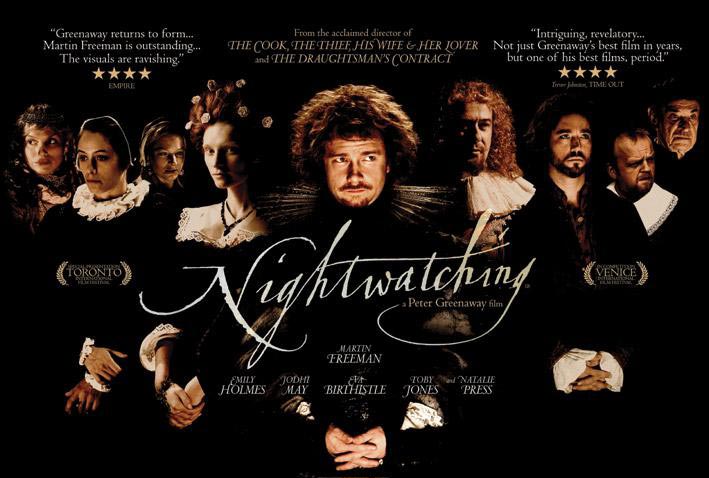
Distribution: Martin Freeman , Emily Holmes , Eva Birthistle , Jodhi May , Toby Jones , Natalie Press Michael Teigen
Producer: Co-production GB-Poland-Canada-Netherlands
Gender: drama | Biographic . XVII century . Painting
Synopsis:
It portrays a tragic period in the life of the painter Rembrandt van Rijn, when the artist loses his wife and three children. At that time, around 1642, it is when - on request - he painted one of his best known paintings, 'The Night Watch', the canvas that reflects the conspiracy of a vile murder. (FILMAFFINITY)
Awards
2007: Venice Film F
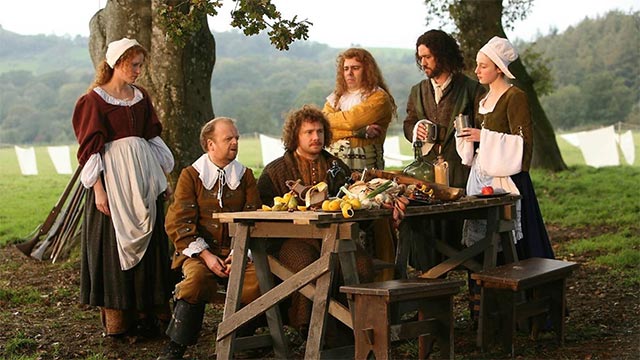
TOMATOMETER CRITICS 76% | AUDIENCE 62%
CRITICS REVIEWS
March 25, 2010
**** Trevor Johnston Time Out Top Critic
This intriguing and revelatory blend of human drama and art-history detective work argues that Rembrandt peppered the canvas of his masterpiece ‘The Night Watch’ with a cleverly coded attack on the Amsterdam bigwigs whose egos he was commissioned to flatter. Deftly combining character study and cultural documentary, it marks Peter Greenaway’s return to the cinema after years of museum installations and multimedia work. He’s been guilty of patience-testing pretension in the past, but this is impressively focused and accessible, shaped around a truly expressive balls-out performance from Martin Freeman as Rembrandt. What’s surprising (in the context of Greenaway’s often chilly past oeuvre) is the film’s genuine compassion for the sufferings of wives, maids and vulnerable orphans, adding an emotive underpinning to its sharp observations on the purpose of art and the nature of representation. It’s not just Greenaway’s best film in years, but one of his best films, period.
+++
March 6, 2009
** Peter Howell Toronto Star Top Critic
Starring Martin Freeman, Eva Birthistle, Jodhi May and Emily Holmes. Written and directed by Peter Greenaway. 134 minutes. At the Cumberland. 18A
The phrase "exasperating elegance" comes to mind in assessing Nightwatching, Peter Greenaway's latest flight of fancy.
The Welsh auteur is in his element in bringing Rembrandt's famed "The Night Watch" to dramatic life, taking a leaf from author Dan Brown's profitable fascination with the artwork of Leonard Da Vinci. More art director than film director, Greenaway puts his visuals ahead of his narratives at all times.
He isn't one to sully his defiantly outré stance by making anything as mainstream as The Da Vinci Code, however. Although Nightwatching is his most linear narrative in some time – and a good deal more satisfying that his tiresome Tulse Luper multimedia indulgences of recent years – Greenaway continues to vex anyone who seeks anything so prosaic as a good story.
What truly galls is that Greenaway has the germ of a great movie here. "The Night Watch" is one of the art world's finest mysteries, with unorthodox elements that have fascinated viewers since the 17th century. Who are the military men depicted in it? Why do they strike such a relaxed pose? Who is the girl at the centre left of the painting, and what does she represent?
Greenaway ventures opinions on all of these questions, but does so obliquely and with no assist to the befuddled. He employs whimsy and pathos to follow the painting from its original commission for Rembrandt (Martin Freeman), which the artist regards as strictly a paycheque gig, through to its completion and subsequent mixed reception.
"Goddamned painting of the militia pretending to be mighty soldiers!" Rembrandt grouses to his wife Saskia (Eva Birthistle), after he is bullied into the assignment by supporters and members of the Amsterdam Musketeer Militia.
Along the way, Rembrandt encounters complications both philosophical and sexual. The former comes by way of his growing dislike of his subjects and his suspicions that they are allied with murder and child prostitution.
On the latter complication, he proves himself easily distracted by the charms of Geertje (Jodhi May), who is far more attentive to him than the pregnant and moody Saskia. Freeman and May are explicitly and repeatedly viewed in the buff, but Freeman has had ample experience in this, since he played the unlikely porn star in Love, Actually.
He's also an unlikely Rembrandt, but a good one, bringing to mind Tom Hulce's energetic portrayal of the composer Wolfgang Amadeus Mozart in Amadeus.
How maddening it is, though, that Greenaway refuses to stitch together anything resembling a coherent storyline. Most of the characters are ill-defined, their scenes disjointed (when not downright mystifying) and their dialogue is often drowned out by a classical score that strays into the bombastic.
Visually, however, Nightwatching is above reproach. Greenaway poses his subjects and lights them much the way Rembrandt did, and the interplay of shadows is amazing. You want to slap the ninny who complains, gazing upon the completed painting, "Bring on some candles!"
But then you might also feel like slapping Greenaway for being such a stubborn and uncompromising cuss.
+++
May 18, 2010 | Rating: B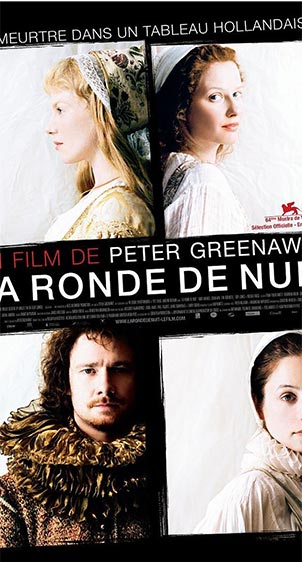
Dennis Schwartz Ozus' World Movie Reviews
"Like all Greenaway films, it's not for all tastes."
Cinema provocateur Peter Greenaway ("8 1/2 Women"/"Prospero's Books"/"The Belly of an Architect") directs this visually pleasing highly personal biopic of the Dutch painter Rembrandt (Martin Freeman) that also can be viewed as an oddball art history lesson involving a murder plot (with Greenaway playing fast and loose with the facts to give us a look into the troubled mind of the painter who must face his critics, as he offers groundbreaking art). It focuses on 1642, when the painter goes from a wealthy respected painter to a discredited pauper. Following his nagging pregnant wife Saskia's (Eva Birthistle) advice, the reluctant Rembrandt takes on the large commission to paint the Amsterdam Musketeer Militia in a group portrait of the 18 that would later become known as The Night Watch and become his masterpiece.
While painting, the artist discovers a murder plot involving his egotistical bigwig subjects he was called on to flatter in this portrait and becomes determined to expose the conspiracy. Rembrandt builds his accusation in the form of his painting, following through on his decision to uncover the seamy and hypocritical side to Dutch Society in the Golden Age. But his good fortunes change as Saskia dies. Meanwhile Rembrandt builds his case for the murder plot involving conflict over finances among his arrogant subjects, but the conspirators plan revenge and discredit him by planting a caretaker, Geertje (Jodhi May), to seduce him and become his mistress. They further diabolically plan his social and financial ruin, and succeed into driving him into poverty, insult his young mistress Hendrickje (Emily Holmes), conspire to destroy his son, and eventually bring Rembrandt to ruin.
The film is shot for the most part from around the artist's bed, and the opulent richly colored film looks as if it were a canvas being painted. It's an exotic look at the mystery behind Rembrandt's famous painting, and should be pleasing to Greenaway fans. But like all Greenaway films, it's not for all tastes. Be warned that Greenaway's take on the painting is interesting but questionable.
+++
AUDIENCE REVIEWS
**** Nosferati Ipsum January 25, 2012
I loved the art and the sets, but could not find a coherent story. I was more enthralled with the extras than the main characters, so needless to say I am not a fan of this film. But the fellow who sat next to me made the entire evening worthwhile. Before the show started he and I had a marvelous conversation that started after I complimented him on his amazing Batman hoodie. It was a brilliant print of exceptional detail and color. I learned that the process is called sublimation, which is a photographic type of screening where each shirt is individually printed so each is slightly different due to flaws. He revealed his source. My 12 year old son is a huge Batman fan so I'm very pleased to now know for certain where I can buy his birthday present. Their Batman hoodie & t shirt displays are far superior to any other merchant because you can see a giant blowup of each aspect. Also you can search their inventory by image, so finding the perfect shirt is a breeze. So as you can see by my review, I learned something valuable at the theatre, but it had nothing to do with the film or Rembrandt.
+++
**** Lilianetty l January 15, 2012
Defenetly loved it! When the movie started I was seeing theater instead of a movie. You will think I'm mad, but the way it was filmed, it looked to me as I was watching a play in real life without being there really watching it. It was so interesting from that perspective, I enjoyed the 2 hours and 15 minutes it lasts. Really, a great job from director, crew and cast no doubt!
Plot: Rembrandt is a famous artist or may I say painter from the 17 century. I never heard of him but now I will do research of his paintings (which the ones showed in the movie look amazing and very well done...yes, those are real ones or just copies of the real ones). But seriously, if this was Rembrandt life, it was a mix of tragedy with a long time drama that had a painful ending but still his paintings (arts) will be remember forever. Stars? Defenetly yes.
Acting: Bravo Martin Freeman! Defenetly an excellent job. This man has made of this role his own, he nailed it. I was shocked in some scenes but anyway, it was a magnific job. Same from Eva as May, incredible actress and what a talent. Toby (my fave Dobby voice over actor) did also an explendit work. Emily, Natalie and Jodhi and the rest of the male cast, were explendit and marvelous. Really, no more words, since everyone here did an excellent job and defenetly this movie will be one of those inspirational movies I will re-watch if I get to have the chance to study it or do a play based on this century someday. Stars for everyone.
Music: Best part evar. The musicians did also an incredible and bloody brilliant job! Loved it from start to the very ending. Stars for everyone too!
To end this 7th Art review, 4 stars of 5. Enjoy and HASTA LA PROXIMA AMIGOS/AS! CHAO! BLESS YOU ALL!!!
+++
December 15, 2011
Eric B *** ½ Super Reviewer
Certainly, "Nightwatching" -- writer/director Peter Greenaway's inventive take on Rembrandt's masterpiece "The Night Watch" -- has a brilliant premise. Ever obsessed with detail to queasy extremes, Greenaway revisits the portrait and imagines that it contains veiled attacks upon its pictured military elite. (I suspect his initial inspiration came from snickering at the central figure's hand shadow, which seems to "grope" the crotch of an adjacent man.)
Martin Freeman (best known for a much different role in the British version of "The Office") portrays Rembrandt as an incorrigible, vulgar smart-ass. Indeed, his wisecracking manner seems almost anachronistic, though a passing reference to Manhattan suggests that such impressions may be intentional. In a film about a legendary painter which never actually shows him painting, narrative aberrations must be expected.
Rembrandt's kindred spirit is his sharp-tongued wife Saskia, who becomes pregnant early in the plot. Unfortunately, this was the 1600's and childbirth was a much riskier procedure. In bearing their son Titus, Saskia has internal complications from which she never recovers.
Meanwhile, a dubious group of military noblemen commissions Rembrandt to paint their portrait. He skeptically accepts the job because he needs the money. But once the project becomes underway, he learns of various acts of debauchery, violence and cruelty that these men have committed. So, he decides to subtly incorporate clues about their sins into the painting. Wickedly ingenious.
All this is fascinating, but the script makes a poor choice in positioning the work's climactic unveiling (and its subjects' furious response) with about 45 minutes left in the film. From there, the story just treads water. Greenaway mostly uses the extra time to boost the nudity content (which had been unusually low by his standards, up until then). We see the militia wreak its revenge, draining Rembrandt's prestige and fortune, and there's one valuable scene where a character analyzes the differences between "The Night Watch" and the era's more stiffly posed portraits. But elsewhere, the attention paid to Rembrandt's subsequent mistress and second wife seems off-topic -- this is a film about the creation of a painting, not a biography.
The theatrical staging, dim lighting and meticulous production design will be familiar to the director's fans, but "Nightwatching" is not as fiendishly structured as some other Greenaway movies and -- except for its length -- it's easier to watch. If you're looking for an entry point to this filmmaker and his uniquely intellectual style, this is one of the better candidates.
+++
Man October 9, 2010
***** The Berg Man The Berg
Director Peter Greenaway becomes himself the hero of his previous triumph, The Belly of an Architect with Nightwatching, a film about the creation of Rembrandt's infamous portrait of a wealthy Dutch militia. In Architect, Greenaway constructs the story of an American architect planning an exhibition in Rome on the works of an obscure French enlightenment-era architect. The American, played wonderfully by Brian Dennehy obsesses over the works and life of Etienne-Louis Boullée, writing him postcards constantly. His obsession is also over his own sickness, and as the title implies, his belly. In Nightwatching, Greenaway, the painting enthusiast obsesses over Rembrandt (especially considering along with Nightwatching, he also made the documentary Rembrandt's J'accuse about the mysteries surrounding the painting, which I have yet to watch).
In the movie, Rembrandt is persuaded to paint the portrait by his wife against his will. When plots and conspiracies begin to spring up amongst the men of the militia, including one mysterious death, illegitimate children in an orphanage/brothel, and mysterious disappearances, Rembrandt decides to pursue the project as a means of exposing the militia as the actors they are. Rembrandt's private life gets thrown into turmoil along the way when his wife falls ill after a troubled pregnancy. Eventually, the painting is completed and Rembrandt is left alone to watch his life fall to pieces.
If you are at all familiar with Greenaway's work, the film's look will not be a surprise at all. Greenaway despises the mainstream's reliance on a novel structure in film making; instead granting primacy to the visuals over the narrative. However, like Architect, Night Watching is rather straightforward by his standards (as opposed to the impossible to follow but undoubted masterpiece The Draughtsman's Contract). His frames are very much constructed like the frames of a painting. Never is anything implied, it is always on screen, though possibly only in allusion. Greenaway first and foremost is a producer of images, and as such, has made some of the most visually spectacular films I've ever seen. Even lesser works like 8 1/2 Women are still visually marvelous, even if otherwise unimpressive.
Also a trademark of Greenaway's work is the pacing. It essentially moves as fast as the average painting. But with so much to be seen, this is never really a hindrance (though bits of the last hour do drag a bit longer than need be). It's masterfully constructed, resulting in an almost Oedipal tragedy by the conclusion.
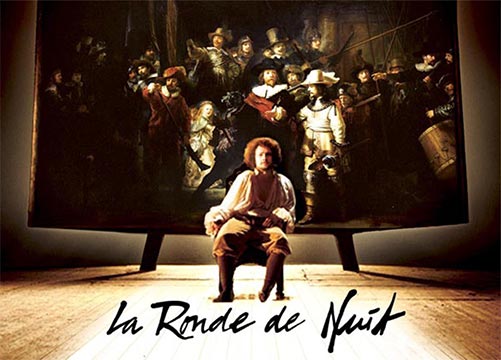
There is only one issue I can raise with this film, and I'm sure it can be easily explained on thematic grounds. Rembrandt's painting The Night Watch is not a night scene at all, as has been well noted. The painting has darkened over time from what was originally a day setting. Why Greenaway, who undoubtedly knows this, chose to use the painting as it appears now, as opposed to as it must have appeared when new is a bit perplexing. However, given the thematic emphasis Greenaway places on Rembrandt's frequent searching, often on his roof staring blankly into the night's sky, it seems obvious that this wasn't a simple mistake, but rather a calculated decision. Whether or not the painting is a night scene doesn't actually matter to the movie; the night scene that appears at present better serves motifs found in the film, and thus is the more fitting version for the film.
I don't think I would consider this Greenaway's best work. It would be hard for any director to top a film like his 1988 work of art, The Cook, The Thief, His Wife and Her Lover. However, I feel this film does come close. The drama is more human than in most of Greenaway's works. The characters actually resemble characters as would appear in movies, as opposed to his usual bias toward creating characters as they would appear in paintings. Yet the film is still made with careful magnificence that only Greenaway seems capable. I can't think of another director who can even make some of his worst films look so amazingly good. Luckily, this is not one of his worst films.
Now if only someone could convince Greenaway to make a film about Velazquez.
More Background On NightwatchingTheFilm.com
NightwatchingTheFilm.com once served as the official website for Nightwatching (2007), a visually ambitious historical drama written and directed by acclaimed British filmmaker Peter Greenaway. Dedicated to the life, art, and controversies surrounding the Dutch master Rembrandt van Rijn, the site functioned as a central informational hub for audiences, critics, educators, and cinephiles seeking deeper engagement with the film and its provocative interpretation of one of Western art history’s most famous paintings, The Night Watch.
More than a promotional landing page, NightwatchingTheFilm.com reflected Greenaway’s broader artistic philosophy: cinema as an extension of painting, architecture, and intellectual inquiry. The site combined factual film information, critical reception, synopsis material, and contextual references that framed Nightwatching not merely as a biographical drama, but as an art-historical investigation and cultural argument rendered through cinema.
Although no longer active in its original form, NightwatchingTheFilm.com remains an important digital artifact of mid-2000s independent and art-house film culture, representing a time when official film websites served as curated archives rather than fleeting marketing microsites.
Ownership and Creative Stewardship
NightwatchingTheFilm.com was associated with the production and distribution ecosystem behind Nightwatching (2007), a multinational co-production involving partners in the United Kingdom, Poland, Canada, and the Netherlands. The film was written and directed by Peter Greenaway, a filmmaker known for his meticulous control over both form and content. As such, the site’s tone and structure closely mirrored Greenaway’s intellectual rigor and aesthetic priorities.
While the website itself did not foreground corporate branding or studio identity, its content and presentation clearly aligned with Greenaway’s authorship. The site emphasized themes of art history, visual composition, and critical discourse rather than mainstream promotional tactics, reflecting a filmmaker-led approach to audience engagement rather than a studio-driven one.
Historical Context of the Film
Released in 2007, Nightwatching explores a pivotal period in Rembrandt’s life around 1642, when the painter was commissioned to create what would later become known as The Night Watch. According to the film’s narrative, this period coincided with immense personal tragedy for Rembrandt, including the loss of his wife Saskia and his children, as well as professional conflict and social alienation.
The film proposes a controversial thesis: that The Night Watch is not merely a group portrait of the Amsterdam Musketeer Militia, but a coded visual indictment of corruption, conspiracy, and murder among the powerful elites who commissioned it. NightwatchingTheFilm.com embraced this premise and framed the film as both drama and detective story, inviting audiences to reconsider one of the most analyzed paintings in Western art.
Location, Setting, and Cultural Geography
Although Nightwatching is set in 17th-century Amsterdam, its production and promotion were deeply international. The website reflected this transnational character, presenting the film as a European cultural project with global intellectual relevance.
The story’s physical proximity to historic Amsterdam, Dutch civic institutions, and the cultural memory of the Dutch Golden Age was central to its identity. For viewers and readers encountering NightwatchingTheFilm.com, the site functioned as a virtual gateway into this historical and geographic context, situating the film within a lineage of European art, politics, and social power structures.
Film Details and Technical Profile
NightwatchingTheFilm.com prominently documented the film’s essential technical details:
-
Original Title: Nightwatching
-
Year: 2007
-
Duration: 134 minutes
-
Genre: Biographical drama; historical; art-themed
-
Director and Screenwriter: Peter Greenaway
-
Music: Włodzimierz Pawlik
-
Cinematography: Reinier van Brummelen
The website underscored the collaborative artistry behind the film, particularly the role of cinematography and music in translating painterly aesthetics into moving images. Greenaway’s long-standing interest in composition, symmetry, and light was repeatedly highlighted as a defining characteristic of the project.
Cast and Performances
A key feature of NightwatchingTheFilm.com was its emphasis on performance, particularly Martin Freeman’s portrayal of Rembrandt van Rijn. Known at the time for television roles that contrasted sharply with this part, Freeman’s casting was presented as a deliberate subversion of expectations.
The principal cast included:
-
Martin Freeman as Rembrandt
-
Eva Birthistle as Saskia
-
Jodhi May as Geertje
-
Emily Holmes as Hendrickje
-
Toby Jones in a supporting role
-
Natalie Press in a supporting role
The site positioned these performances as integral to the film’s emotional core, balancing Greenaway’s intellectual ambitions with moments of human vulnerability, grief, desire, and defiance.
Goals and Artistic Intent
One of the defining aspects of NightwatchingTheFilm.com was its clarity of purpose. The site did not merely seek to promote ticket sales; it articulated a set of artistic and intellectual goals:
-
To challenge conventional interpretations of The Night Watch
-
To foreground visual literacy and art-historical analysis
-
To question the relationship between patronage, power, and artistic freedom
-
To explore how personal tragedy intersects with public creation
By presenting the film as an argument rather than a passive narrative, the website positioned its audience as active participants in interpretation.
Critical Reception and Popularity
NightwatchingTheFilm.com prominently featured critical responses, drawing from established review aggregators and major publications. At the time, the film achieved a 76% critics’ score and a 62% audience score, reflecting its polarizing but respected status.
The site showcased excerpts from critics who praised the film’s ambition, visual mastery, and intellectual daring, while also acknowledging that Greenaway’s style was not universally accessible. This balanced presentation reinforced the site’s credibility and appealed to discerning viewers interested in challenging cinema.
Awards and Festival Presence
The film’s participation in major international film festivals, including Venice, was highlighted as a marker of prestige and artistic seriousness. While Nightwatching was not positioned as a conventional awards-season contender, its festival screenings underscored its relevance within global art-house cinema.
NightwatchingTheFilm.com used these appearances to frame the film as part of an ongoing conversation about the boundaries of cinematic storytelling.
Audience and Intended Viewership
The website clearly targeted a specific audience rather than a mass market. Its primary viewers included:
-
Art historians and students
-
Museum professionals and curators
-
Independent film enthusiasts
-
Academics interested in visual culture
-
Fans of Peter Greenaway’s earlier work
By doing so, NightwatchingTheFilm.com functioned as an educational and cultural resource as much as a promotional platform.
Press and Media Coverage
Press excerpts on the site reflected broad international interest, particularly from critics known for engaging seriously with art-driven cinema. Reviews often emphasized the film’s theatrical staging, painterly lighting, and philosophical density.
Rather than simplifying these responses, the website embraced complexity, reinforcing the idea that Nightwatching was designed to provoke debate rather than consensus.
Cultural and Social Significance
NightwatchingTheFilm.com occupies a distinctive place in early 21st-century digital film culture. It represents a moment when official film websites were carefully curated extensions of a director’s vision rather than disposable marketing tools.
Culturally, the site contributed to renewed public interest in Rembrandt not just as a painter, but as a figure embedded in political, economic, and moral conflict. Socially, it encouraged viewers to reconsider how art can function as dissent, encoded critique, and historical testimony.
Educational and Interpretive Value
Educators frequently referenced the film and its associated materials when discussing:
-
Visual symbolism in cinema
-
Historical fiction versus historical fact
-
Patronage systems in art history
-
The translation of static images into narrative form
NightwatchingTheFilm.com supported this use by presenting coherent summaries, thematic explanations, and critical perspectives without reducing the material to simplistic talking points.
Design Philosophy and User Experience
While not flashy by contemporary standards, the website’s design emphasized clarity and seriousness. Text-forward presentation, structured sections, and restrained visual elements reflected the tone of the film itself.
This approach stood in contrast to more commercial movie websites of the era, reinforcing the sense that NightwatchingTheFilm.com was aimed at thoughtful engagement rather than spectacle.
Preservation and Legacy
Today, NightwatchingTheFilm.com survives primarily through archival captures and preserved text, functioning as a historical record of how Nightwatching was framed, interpreted, and contextualized at the time of its release.
Its legacy lies not only in promoting a single film, but in demonstrating how a website can serve as a lasting cultural document—one that bridges cinema, art history, and intellectual inquiry.
NightwatchingTheFilm.com was far more than an official movie website. It was an extension of Peter Greenaway’s artistic project: a platform for re-examining history, challenging dominant narratives, and insisting on the relevance of visual literacy in a media-saturated world.
Through its emphasis on critical discourse, artistic intent, and historical depth, the site helped position Nightwatching as a significant work within modern art-house cinema. Even in archival form, NightwatchingTheFilm.com remains a valuable resource for understanding how digital spaces once supported serious cultural engagement with film and art.